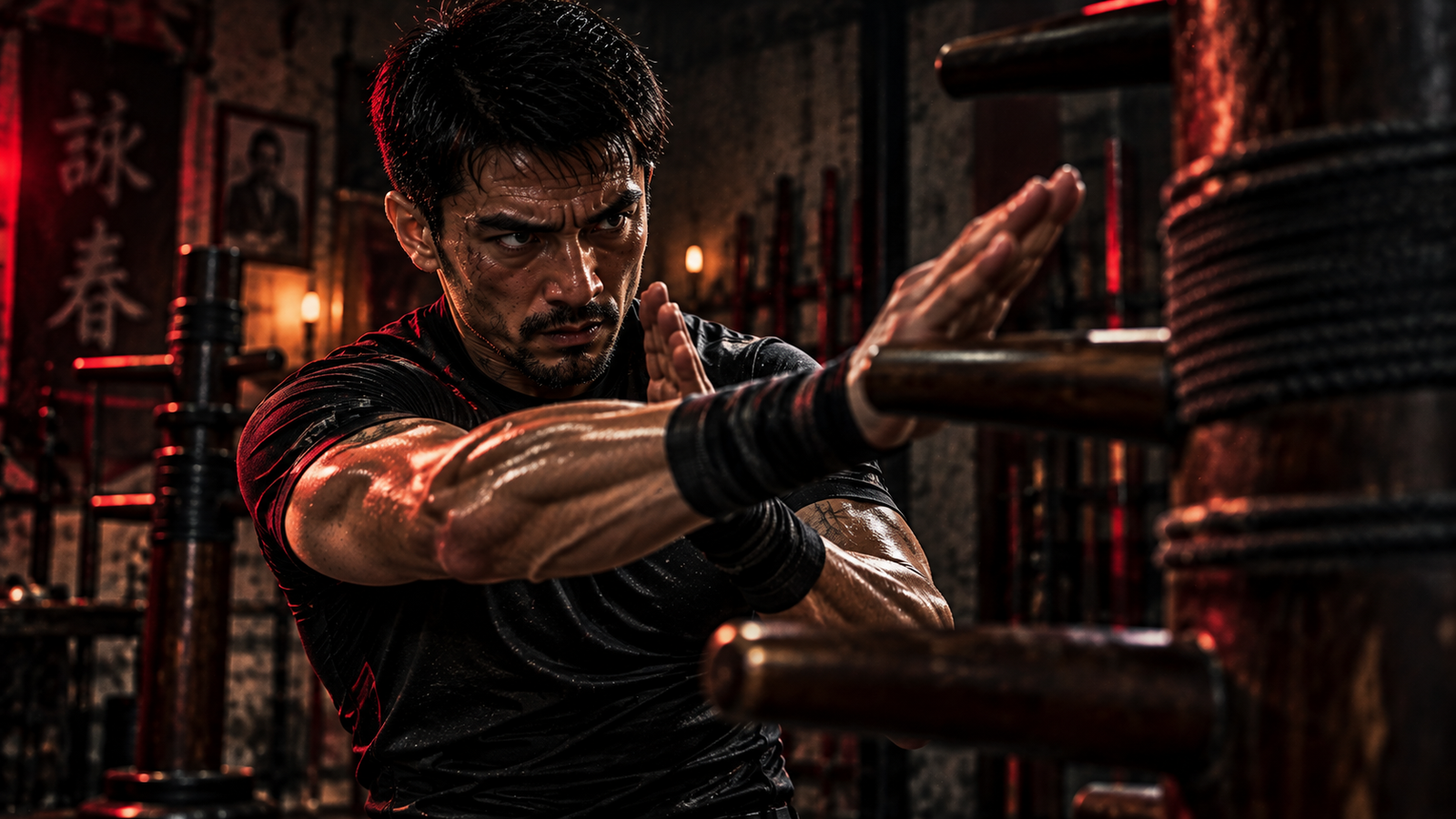
Centerline Science & Close-Range Combat
Wing Chun (Wing Tsun) is an authentic Southern Chinese combat science built on mathematics, biomechanical economy, and centerline dominance. Taught in New Delhi by Guro Akshay Ali (whose martial lineage traces to Shaolin Gurukul and Bruce Lee's Jun Fan roots), our Wing Chun program turns close-quarters chaos into calm tactical dominance.
The Southern Kung Fu Science
Control the imaginary line through your opponent's vital organs. Attack through the shortest geometric path while occupying their defense.
Develop neuro-muscular contact reflexes. Feel the enemy's pressure, redirect incoming force, and counterattack without relying on visual speed.
Eliminate the two-beat trap of blocking then striking. Deflect and land devastating vertical chain punches in one single, fluid heartbeat.
The Martial Foundation of Bruce Lee
Originating in Southern China during the Qing dynasty, Wing Chun was engineered specifically for close-range survival in crowded alleys and tight quarters where long swings and high kicks are impractical.
Unlike martial styles relying on raw muscular strength or size, Wing Chun uses structural angles, triangular geometry, and bone alignment. A smaller, lighter practitioner can easily redirect a heavier opponent's momentum.
Famously mastered by Grandmaster Ip Man and serving as the primary striking foundation for Bruce Lee’s Jeet Kune Do, Wing Chun remains one of the world's most scientifically refined close-combat systems.
The 'Little Idea' form building elbow positions, skeletal rooting, and deep internal structure.
'Seeking the Bridge': dynamic footwork, waist torque, kicking, and distance closing.
The legendary Wooden Dummy training hardening forearms, angle recovery, and limb trapping.
Pressure-tested against modern street aggression, wild haymakers, and unexpected clinch entries.
Got Questions?
Absolutely. Wing Chun was created specifically for urban self-defense without rules. It focuses on the shortest distance to strike vulnerable targets (throat, eyes, groin, knees) and excels in confined spaces where boxers and kickboxers cannot generate full swings.
Wing Chun was Bruce Lee’s mother art taught by Ip Man. While Wing Chun specializes in close-quarter trapping and centerline efficiency, Jeet Kune Do integrated Western boxing footwork and fencing range principles. At Akshay MMA, learning both gives you complete control from long range to chest-to-chest infighting.
No. Wing Chun was traditionally developed by a Buddhist nun (Ng Mui) specifically to defeat larger, muscular attackers using leverage, relaxed deflection, and structural alignment rather than muscular resistance.